The Ultimate Guide to Employee Performance Management Systems
Employee performance is one of the biggest factors that determine whether a business grows or struggles. Organizations that provide employees with clear goals, continuous feedback, and regular performance reviews consistently achieve better productivity, higher employee engagement, and improved retention.
Traditional annual performance appraisals are no longer enough. Modern businesses need an employee performance management system that supports continuous improvement rather than once-a-year evaluations.
In this guide, you’ll learn everything about employee performance management systems, including their benefits, best practices, common challenges, emerging AI trends, and how the right HR software can simplify the entire process.
What is an Employee Performance Management System?
An employee performance management system is a structured process, supported by technology, that helps organizations monitor, evaluate, and improve employee performance throughout the year.
Rather than focusing only on annual appraisals, modern performance management emphasizes continuous communication between managers and employees.
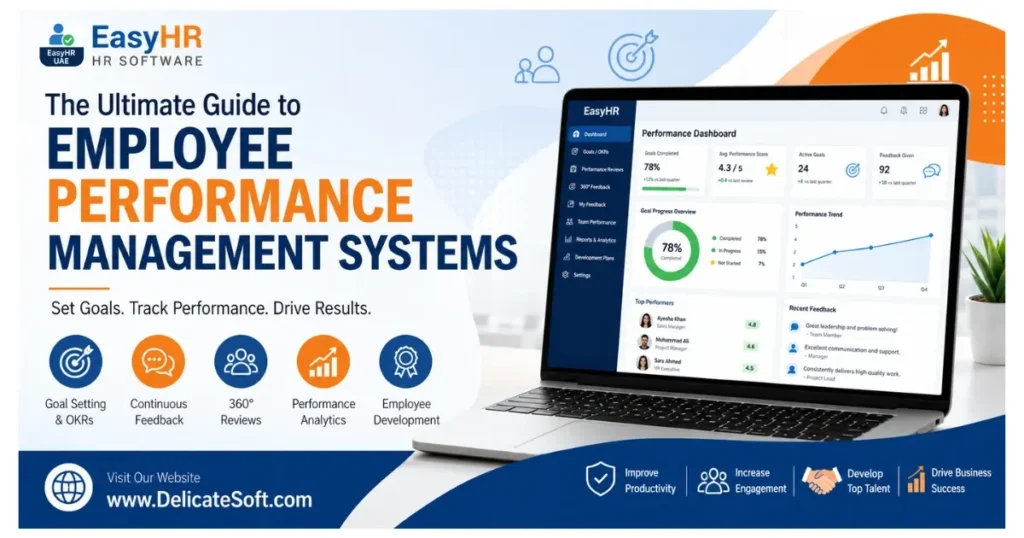
A comprehensive performance management software solution typically includes:
- Goal setting
- KPI tracking
- OKR management
- Continuous feedback
- Performance reviews
- Competency assessments
- Employee development plans
- Analytics and reporting
The objective is simple:
Help employees succeed while enabling organizations to achieve their business goals.
Why Performance Management Matters
Organizations invest heavily in recruitment and training. Without an effective performance management process, these investments often fail to deliver expected results.
An effective system helps businesses:
- Improve employee productivity
- Increase employee engagement
- Identify high performers
- Detect skill gaps early
- Reduce employee turnover
- Build future leaders
- Align employees with company objectives
Companies that continuously manage performance are generally more agile and better prepared for changing business conditions.
Key Components of a Modern Performance Management System
1. Goal Setting
Employees perform better when expectations are clear.
Modern organizations use SMART goals or OKRs to ensure every employee understands:
- What needs to be achieved
- Why it matters
- How success is measured
- When it should be completed
Example:
| Poor Goal | Better Goal |
|---|---|
| Improve sales | Increase monthly sales by 15% before Q4 |
| Improve support | Reduce ticket resolution time to under 4 hours |
| Better attendance | Maintain 98% attendance for six months |
2. Continuous Feedback
Traditional annual reviews often provide feedback too late.
Continuous performance management encourages:
- Weekly check-ins
- Monthly one-to-one meetings
- Real-time recognition
- Coaching conversations
- Immediate corrective actions
Employees appreciate timely feedback because it helps them improve before small issues become major problems.
3. Performance Reviews
Formal reviews remain an important part of performance management.
Typical review methods include:
- Self-assessment
- Manager assessment
- Peer review
- Team review
- Project review
These evaluations help managers identify strengths, weaknesses, achievements, and future development opportunities.
4. 360-Degree Feedback
Many organizations now use 360-degree reviews instead of relying solely on a manager’s opinion.
Feedback may come from:
- Managers
- Peers
- Team members
- Direct reports
- Internal customers
- External customers
This approach provides a more balanced picture of employee performance.
Benefits include:
- Reduced bias
- Better self-awareness
- Improved teamwork
- Stronger leadership development
5. Learning and Development
Performance management should focus on growth, not just evaluation.
Development plans may include:
- Training courses
- Coaching
- Mentoring
- Job rotation
- Certifications
- Leadership programs
Employees who see career growth opportunities are more likely to remain with the company.
6. Analytics and Reporting
Modern HR software for performance reviews provides dashboards that help HR teams answer questions like:
- Which departments perform best?
- Which employees consistently exceed expectations?
- Where are skill gaps?
- Which managers provide regular feedback?
- How are performance scores changing over time?
Data-driven decision making is one of the biggest advantages of digital performance management.
Benefits of Using Performance Management Software
Implementing dedicated performance management software offers significant advantages over spreadsheets and paper-based evaluations.
Better Goal Alignment
Employees understand how their work contributes to company objectives.
Higher Employee Engagement
Frequent communication keeps employees motivated and connected.
Improved Productivity
Regular feedback helps employees improve faster.
Fairer Performance Reviews
Standardized evaluation criteria reduce bias.
Better Talent Retention
Employees who receive coaching and recognition are more likely to stay.
Faster Decision Making
Managers gain instant access to performance data.
Easier Compliance
Performance records are securely stored and easily accessible for audits or internal reviews.
Reduced Administrative Work
Automation eliminates manual paperwork and repetitive HR tasks.
Best Practices for Successful Performance Management
Set Clear Expectations
Employees should understand:
- Their goals
- KPIs
- Deadlines
- Performance standards
Ambiguity often leads to poor performance.
Focus on Continuous Performance Management
Rather than waiting for annual reviews, schedule:
- Monthly reviews
- Quarterly discussions
- Weekly coaching sessions
Continuous conversations build trust and improve accountability.
Use Measurable KPIs
Avoid vague objectives.
Instead of:
“Improve customer service”
Use:
“Achieve a customer satisfaction score above 95%.”
Encourage Two-Way Feedback
Performance discussions should not be one-sided.
Employees should feel comfortable:
- Sharing ideas
- Discussing challenges
- Requesting support
- Suggesting improvements
Recognize Achievements
Recognition can include:
- Public appreciation
- Awards
- Bonuses
- Promotions
- Additional responsibilities
Employees who feel appreciated often perform better.
Train Managers
Even the best employee performance management system cannot compensate for poor management.
Managers should be trained in:
- Coaching
- Active listening
- Giving constructive feedback
- Handling difficult conversations
- Setting realistic goals
Common Challenges in Performance Management
Many organizations face similar obstacles.
Inconsistent Reviews
Different managers may evaluate employees differently.
Solution:
Use standardized scorecards and evaluation criteria.
Lack of Regular Feedback
Waiting an entire year to discuss performance reduces effectiveness.
Solution:
Adopt continuous performance management.
Subjective Evaluations
Personal bias can affect ratings.
Solution:
Use measurable KPIs and 360-degree feedback.
Employee Resistance
Employees may fear reviews.
Solution:
Position reviews as coaching opportunities rather than criticism.
Manual Processes
Paper forms and spreadsheets consume valuable HR time.
Solution:
Use modern performance management software that automates reminders, workflows, and reporting.
Modern Trends in Employee Performance Management
Technology is transforming HR faster than ever.
AI in HR
Artificial Intelligence is changing performance management by helping organizations:
- Identify performance trends
- Detect skill gaps
- Recommend learning programs
- Predict employee turnover
- Generate intelligent performance insights
- Assist managers with review summaries
AI helps HR professionals make faster, more informed decisions while reducing administrative work.
Real-Time Analytics
Instead of waiting for quarterly reports, HR leaders can monitor live dashboards showing:
- Goal completion
- Employee engagement
- Department performance
- Manager effectiveness
- Productivity trends
Real-time analytics enable proactive decision making.
OKR Software
Many organizations now use OKR software to align individual goals with company objectives.
Objectives define what employees want to achieve.
Key Results measure success using specific metrics.
Example:
Objective:
Deliver exceptional customer service.
Key Results:
- Achieve 95% customer satisfaction
- Reduce response time by 20%
- Resolve 90% of issues on first contact
Employee Self-Service
Modern HRMS tools allow employees to:
- View goals
- Update progress
- Complete self-assessments
- Request feedback
- Track achievements
Self-service increases transparency and ownership.
Mobile Performance Reviews
Remote and hybrid workforces increasingly require mobile-friendly HR applications that enable managers and employees to complete reviews anytime, anywhere.
How EasyHR Helps Simplify Performance Management
Choosing the right technology is just as important as designing the right process.
EasyHR HR Software helps organizations modernize their performance management process by replacing spreadsheets and manual paperwork with a centralized digital platform.
With EasyHR, HR teams can:
- Define employee goals and KPIs
- Support OKR-based performance tracking
- Schedule and manage performance reviews
- Record continuous feedback
- Generate performance reports and analytics
- Maintain employee performance history securely
- Improve transparency between managers and employees
Instead of spending hours compiling spreadsheets and reports, HR professionals can focus on coaching employees and improving organizational performance.
Choosing the Right Performance Management Software
When evaluating solutions, consider these essential features:
| Feature | Why It Matters |
| Goal Management | Align employees with business objectives |
| Continuous Feedback | Encourage regular coaching |
| 360-Degree Reviews | Reduce evaluation bias |
| OKR Management | Measure strategic progress |
| Performance Dashboards | Support data-driven decisions |
| Analytics | Identify trends and improvement opportunities |
| Mobile Access | Enable reviews anywhere |
| Integration with HRMS | Eliminate duplicate data entry |
| Role-Based Security | Protect confidential employee information |
| Custom Review Templates | Adapt to different departments and roles |
Selecting software that integrates with your broader HRMS tools can streamline HR operations and improve data accuracy.
Conclusion
An effective employee performance management system is no longer optional for organizations that want to build high-performing teams. Modern businesses require continuous feedback, measurable goals, meaningful coaching, and data-driven insights to help employees reach their full potential.
By adopting performance management software and embracing practices such as continuous performance management, OKRs, 360-degree feedback, and AI-powered analytics, organizations can improve employee engagement, increase productivity, and make better talent decisions.
Solutions like EasyHR HR Software make this process easier by automating performance reviews, tracking goals, supporting OKRs, and delivering actionable analytics, allowing HR teams to spend less time on administration and more time developing people.
Ready to Improve Employee Performance?
If you’re looking for a smarter way to manage employee goals, automate performance reviews, and gain meaningful workforce insights, explore EasyHR HR Software.