Top 10 HR Interview Questions and How to Answer Them in the UAE
Preparing for a job interview can be stressful, especially in the competitive UAE job market. Whether you are applying for a position in Dubai, Abu Dhabi, Sharjah, or another emirate, interviewers are increasingly looking beyond your CV to understand your skills, problem-solving ability, communication, adaptability, technology knowledge, and potential contribution to the business.
UAE employers are increasingly moving towards skills-based hiring, where practical capabilities and demonstrated skills can matter as much as traditional qualifications and job titles. Recruiters are also placing greater importance on future-ready skills, including AI and digital literacy, problem-solving, communication, strategic thinking, and data analysis.
This means that simply memorizing standard interview answers is no longer enough.
You need to show the interviewer what you can do, how you think, and what value you can bring to the organization.
In this guide, we explain the 10 most common HR interview questions, what the interviewer is really trying to discover, and how you can construct a strong answer.
What Are UAE Employers Looking for During Interviews?
Before looking at individual questions, it is important to understand what modern interviewers are evaluating.
Depending on the position, interviewers may assess:
- Technical and job-specific skills
- Communication skills
- Problem-solving ability
- Adaptability and willingness to learn
- Digital and AI literacy
- Teamwork and collaboration
- Leadership potential
- Commercial awareness
- Reliability and professionalism
- Ability to handle pressure
- Cultural and workplace adaptability
- Salary expectations and availability
- Career goals and motivation
The UAE hiring market has also become more selective. Recruiters have highlighted the importance of demonstrating future-facing skills, digital and AI literacy, problem-solving ability, professional reputation, and a clear value proposition.
Therefore, your interview answers should not simply describe your responsibilities. Wherever possible, explain what you achieved.
1. Tell Me About Yourself
This is one of the most common HR interview questions.
It may sound simple, but it is actually an opportunity to make your first strong impression.
What is the interviewer looking for?
The interviewer wants to understand:
- Your professional background
- Your most relevant experience
- Your key strengths
- Whether your experience matches the vacancy
- How confidently and clearly you communicate
How should you answer?
Do not tell your entire life story.
Use a simple structure:
Present → Past → Achievement → Future
Start by explaining what you currently do, briefly mention relevant experience, highlight one or two achievements, and finish by explaining why the current opportunity interests you.
Example answer
“I am an HR professional with more than five years of experience managing employee records, recruitment coordination, payroll support and employee relations. In my current role, I have helped improve several HR processes and reduce manual administrative work. I particularly enjoy using technology to make HR operations more efficient, and I am now looking for an opportunity where I can take greater responsibility for HR operations and contribute to a growing organization.”
Avoid this mistake
Do not simply repeat everything written on your CV.
Your CV tells the interviewer what you have done.
Your answer should explain why that experience makes you suitable for this particular position.
2. Why Do You Want to Work for Our Company?
This question tests your motivation and whether you have researched the organization.
Weak answer
“Because I need a job and your company is a good company.”
This tells the interviewer very little.
Better approach
Before the interview, research:
- The company’s products or services
- Its industry
- Recent developments
- Company culture
- The job description
- The responsibilities of the position
Then connect your experience to the company’s needs.
Example answer
“I am interested in this position because it combines HR operations with process improvement, which matches my experience. I also researched your company and was impressed by your growth in the UAE market. I believe my experience in employee management and HR administration could help your team manage its growing workforce more efficiently.”
UAE interview tip
Show that you understand the business, not just the job title.
An HR manager wants to know that you are interested in contributing to the organization, not simply obtaining another position.
3. What Are Your Strengths?
This question is designed to determine whether your strengths are relevant to the position.
Do not list ten adjectives such as:
- Hardworking
- Honest
- Punctual
- Friendly
- Positive
Instead, choose two or three strengths that are relevant to the job and support them with examples.
Example
“One of my strongest skills is problem-solving. In my current position, I noticed that a recurring reporting process was taking too much time, so I reorganized the workflow and introduced a more structured approach. Another strength is communication. I regularly coordinate with employees and managers, so I have learned how to explain issues clearly and professionally.”
The key formula
Strength + Example + Result
This makes your answer more credible.
4. What Is Your Biggest Weakness?
This question can be difficult because you do not want to damage your chances by mentioning a weakness that directly affects your ability to perform the job.
Avoid artificial answers such as:
“My biggest weakness is that I work too hard.”
Instead, choose a genuine but manageable weakness and explain how you are improving it.
Example
“Earlier in my career, I sometimes spent too much time trying to perfect smaller details. I have been improving this by prioritizing tasks according to business impact and deadlines. This has helped me become more efficient while maintaining quality.”
The important part is not the weakness itself.
It is your ability to recognize it and improve.
5. Tell Me About a Difficult Problem You Solved
This type of question is becoming increasingly important because employers want evidence of practical problem-solving rather than only theoretical knowledge.
Middle East recruiter research identifies problem-solving as one of the most important skills employers expect from candidates, followed by communication and technology-related skills.
The best method: STAR
Use the STAR method:
S = Situation
What was happening?
T = Task
What were you responsible for?
A = Action
What did you personally do?
R = Result
What happened because of your actions?
Example
“In my previous company, payroll information was being collected from several spreadsheets, which created delays and occasional errors. I was responsible for coordinating the monthly payroll information. I consolidated the data into a structured process and introduced additional verification before final processing. As a result, the payroll process became more organized and the number of corrections required was reduced.”
Whenever possible, include measurable results.
For example:
- Reduced processing time by 30%
- Reduced errors by 20%
- Managed 200 employees
- Improved response time
- Reduced administrative work by several hours per week
Numbers make your achievements easier to understand.
6. How Do You Handle Pressure or Tight Deadlines?
UAE businesses operate in fast-moving environments, and many positions require employees to manage multiple priorities simultaneously.
The interviewer wants to know whether you remain organized and professional under pressure.
A strong answer should demonstrate:
- Prioritization
- Planning
- Communication
- Calm decision-making
- Accountability
Example answer
“When I have several urgent tasks, I first prioritize them according to business impact and deadline. I create a clear task list, identify dependencies, and communicate early if another team is required. I try not to let pressure affect the quality of my work. If priorities change, I reassess the list rather than simply trying to do everything at once.”
This answer demonstrates a process rather than simply saying:
“I work well under pressure.”
7. What Are Your Salary Expectations?
Salary discussions can occur relatively early in UAE recruitment processes, particularly during HR screening.
This is why candidates should research the market before attending an interview.
Do not say:
“Anything is fine.”
It may make you appear unprepared.
Also avoid giving an unrealistic number without understanding the role.
A better approach is to provide a reasonable range based on:
- Your experience
- Skills
- Job responsibilities
- Industry
- Company size
- Current compensation
- Market conditions
Example answer
“Based on the responsibilities of the position and my experience, I would be looking for a package in the range of AED X to AED Y. However, I am open to discussing the overall compensation package and the opportunities associated with the role.”
Remember that total compensation may include more than basic salary.
Depending on the employer and position, the package may include:
- Basic salary
- Housing allowance
- Transport allowance
- Medical insurance
- Annual leave
- Air ticket
- Bonus or commission
- Other benefits
8. Why Should We Hire You?
This is your opportunity to summarize your value.
Do not answer:
“Because I am hardworking and I really need this job.”
Instead, connect your experience directly to the employer’s requirements.
Use this formula
Relevant experience + key skill + achievement + value
Example
“I believe I am a strong fit because I have relevant experience in HR operations, employee management and payroll coordination. I am comfortable working with HR technology and data, and I have experience improving administrative processes. I believe I can contribute from the beginning while continuing to learn and grow with the organization.”
The interviewer should finish your answer knowing exactly what you can bring to the company.
9. Where Do You See Yourself in Five Years?
Employers are generally looking for candidates who have realistic career goals and are interested in developing their skills.
You do not need to predict exactly where you will be in five years.
Instead, talk about:
- Skills you want to develop
- Responsibilities you want to take on
- Leadership or specialist capabilities
- How you want to contribute to the organization
Example
“Over the next five years, I would like to develop deeper expertise in HR technology, people management and strategic HR. I would like to take on increasing responsibility and eventually manage larger HR initiatives or teams. My goal is to build a long-term career while creating measurable value for the organization.”
Avoid saying:
“I want to become CEO.”
unless there is a very credible path to that position.
10. Do You Have Any Questions for Us?
Never automatically say:
“No, I don’t have any questions.”
This is an opportunity to demonstrate genuine interest.
Good questions include:
About the role
“What would success look like in this position during the first six months?”
About the team
“How is the HR team structured, and who would I work with most closely?”
About performance
“What KPIs or objectives are used to measure success in this role?”
About development
“What opportunities are available for professional development and learning?”
About the company
“What are the biggest HR priorities for the company over the next year?”
These questions can make the interview feel more like a professional conversation rather than an examination.
Bonus: UAE Interview Questions You Should Also Prepare For
The ten questions above are common across many industries. However, candidates applying for jobs in the UAE should also prepare for practical questions related to their employment situation.
Depending on the position and employer, you may be asked about:
1. What is your current notice period?
Give an honest answer.
2. When can you join?
Be specific about your realistic joining date.
3. What is your current salary?
Some recruiters may ask this during the screening process. If you are uncomfortable discussing exact figures, you can focus the conversation on your expected range and the overall opportunity.
4. Are you currently based in the UAE?
Answer clearly, particularly if the position requires immediate availability.
5. Do you have relevant UAE industry experience?
If you do, explain the regulations, customers, processes, technologies, or business environment you have worked with.
6. Are you comfortable working with multicultural teams?
The UAE has a highly international workforce, so demonstrate your ability to communicate respectfully and effectively with people from different backgrounds.
However, candidates should remember that employment decisions must follow applicable UAE employment requirements. UAE labour regulations prohibit discrimination that impairs equality of opportunity or prejudices equal treatment in employment on specified protected grounds.
How AI Is Changing Job Interviews in 2026
One of the biggest changes in recruitment is the growing influence of artificial intelligence.
AI is increasingly being used in recruitment workflows, while employers are simultaneously becoming more interested in candidates’ genuine AI and digital capabilities. UAE reporting has highlighted the growing appearance of AI and automation skills in job requirements.
This creates an important change for candidates.
It is no longer enough to write:
“I have AI skills.”
You should be able to explain:
- Which AI tools you use
- What you use them for
- How they improve your productivity
- How you verify AI-generated information
- Where human judgment remains necessary
Example
Instead of saying:
“I know AI.”
Say:
“I use AI tools to help with research, drafting and repetitive tasks, but I verify the output before using it in business decisions. I see AI as a productivity tool rather than a replacement for professional judgment.”
That demonstrates practical AI literacy.
At the same time, candidates should not assume that a polished AI-generated CV or answer can replace genuine experience. Current recruitment discussions increasingly emphasize practical skills, verification and human judgment as AI makes application materials easier to generate.
The STAR Method: A Simple Technique for Better Interview Answers
If you remember only one interview technique from this article, remember STAR.
| Step | Meaning | What to explain |
|---|---|---|
| S | Situation | What was the problem or situation? |
| T | Task | What were you responsible for? |
| A | Action | What did you personally do? |
| R | Result | What was the outcome? |
For example:
Situation: Payroll processing was taking too long.
Task: I was responsible for coordinating employee payroll data.
Action: I standardized the data collection and introduced a verification process.
Result: The payroll process became faster and required fewer corrections.
STAR is particularly useful for questions such as:
- Tell me about a difficult situation.
- Describe a problem you solved.
- Tell me about a time you made a mistake.
- Describe a conflict with a colleague.
- Tell me about a successful project.
- Describe a time you worked under pressure.
- Tell me about a time you demonstrated leadership.
7 Common Interview Mistakes to Avoid
Even strong candidates can lose opportunities because of avoidable mistakes.
1. Giving very long answers
Answer the question directly.
A strong answer does not need to be a five-minute speech.
2. Memorizing answers word-for-word
Interviewers can usually recognize rehearsed answers.
Understand the idea instead.
3. Talking only about responsibilities
Instead of saying:
“I managed payroll.”
Say:
“I managed monthly payroll for X employees and helped improve the payroll verification process.”
Focus on outcomes.
4. Criticizing your previous employer
Even if you had a difficult experience, remain professional.
Explain what you learned rather than attacking the company or manager.
5. Not researching the company
At minimum, understand:
- What the company does
- Its industry
- Its products or services
- The job requirements
- Why you want to work there
6. Ignoring technology
Modern employers increasingly value digital skills and adaptability. Technology and AI skills are becoming more relevant across many roles.
7. Having no questions for the interviewer
Prepare at least two thoughtful questions.
Interview Preparation Checklist
Before your UAE job interview, make sure you can answer:
- Tell me about yourself.
- Why do you want to work here?
- What are your strengths?
- What is your biggest weakness?
- Tell me about a problem you solved.
- How do you handle pressure?
- What are your salary expectations?
- Why should we hire you?
- Where do you see yourself in five years?
- Do you have any questions for us?
- What is your notice period?
- When can you join?
- What are your most relevant technical skills?
- How do you use technology or AI in your work?
- Can you give an example of a measurable achievement?
A Final Tip: Don’t Just Prepare Answers, Prepare Evidence
The best interview preparation is not memorizing 50 answers.
Instead, prepare five to seven real examples from your career.
For example:
- A difficult problem you solved
- A successful project
- A mistake you learned from
- A conflict you handled
- A time you worked under pressure
- A process you improved
- A measurable achievement
Then use these examples to answer different questions using the STAR method.
This makes your answers sound natural, credible and specific.
For HR Managers: How Technology Can Improve the Interview and Hiring Process
Interview preparation is important for candidates, but the other side of the process is equally important.
For HR managers and recruiters, a structured recruitment process can make it easier to maintain consistent candidate records, track recruitment activities and make informed hiring decisions.
As organizations grow, HR teams often move from spreadsheets and separate documents toward centralized HR management systems.
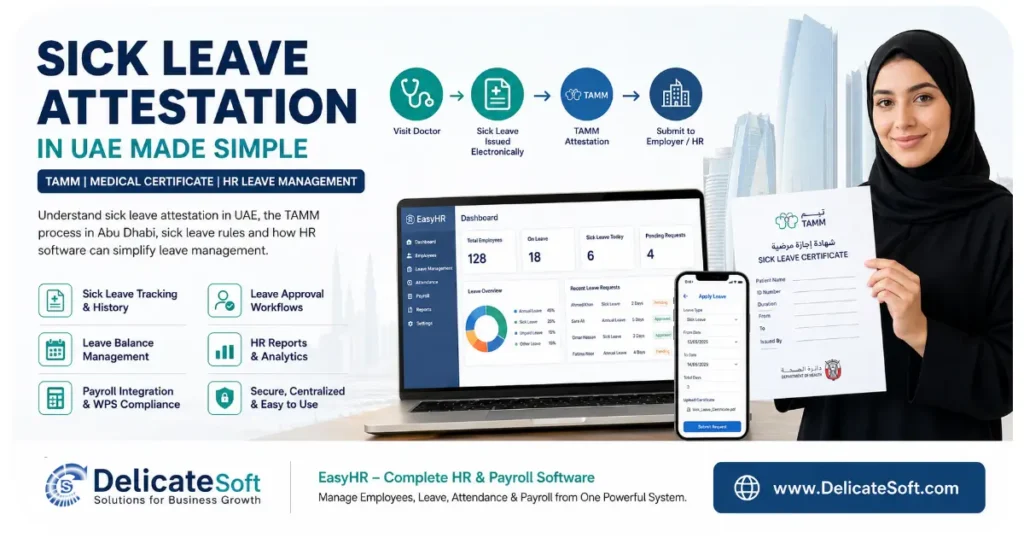
An HRMS can help HR teams manage employee information, attendance, leave, payroll, documents, performance and reporting from a centralized system. For UAE businesses, these functions can also be connected with payroll and WPS workflows.
For example, EasyHR by Delicate Software Solutions brings employee records, attendance, leave, payroll, WPS/SIF file generation, document management, performance, employee self-service and HR reporting into one platform for UAE businesses.
This becomes particularly valuable after the candidate has been hired.
The interview identifies the right person.
The HR system helps your organization manage that employee throughout the employment lifecycle.
From Recruitment to Employee Management
A modern HR process should not stop after making an offer.
Once an employee joins, HR may need to manage:
- Employee personal information
- Employment records
- Salary details
- Attendance
- Leave
- Payroll
- WPS
- Employee documents
- Visa and document expiry dates
- Performance
- Employee requests
- Payslips
- Gratuity and end-of-service information
- HR reports
Managing all of this through spreadsheets, emails and separate files can become increasingly difficult as the company grows.
An integrated HR management system can connect these processes through a centralized employee record. EasyHR, for example, connects employee information with attendance, leave, payroll, payslips, WPS and reporting.
If you are an HR manager, payroll manager or business owner in the UAE and your team is still managing HR through multiple spreadsheets, it may be time to evaluate an HR management system.
Explore EasyHR HR & Payroll Software in UAE
Conclusion
The UAE job market is becoming increasingly skills-focused and technology-aware. Candidates who can demonstrate real skills, measurable achievements, problem-solving ability, communication, adaptability and practical technology knowledge can stand out from applicants who simply provide generic answers.
The best interview strategy is therefore simple:
Understand the question → give a relevant example → explain your action → show the result.
Prepare your real experiences, research the employer, understand the role and practice explaining your achievements clearly.
And if you are an HR professional, remember that successful recruitment is only one part of effective HR management. Once employees join, your organization needs reliable systems for managing employee records, attendance, leave, payroll, documents, WPS and other HR processes.
Learn more about EasyHR HR Management System UAE
Looking for HR management software for your UAE company? Delicate Software Solutions provides EasyHR, an integrated HR and payroll platform designed for UAE businesses, with employee management, attendance, leave, payroll, WPS/SIF, document expiry reminders, performance management, employee self-service and HR reporting.
Book a free EasyHR demo and see how you can streamline your HR operations.