Post-Dated Cheques (PDC) Guide
Post-dated cheques, commonly called PDCs, remain an important payment and cash-flow management tool for many businesses and individuals in the UAE. They are commonly used for rent, supplier payments, installments, property transactions, loans and other scheduled obligations.
Although electronic payments are becoming increasingly common, businesses in Dubai, Abu Dhabi, Sharjah and other parts of the UAE still encounter PDCs regularly. The challenge is that issuing a cheque is relatively simple, while managing dozens or hundreds of future-dated cheques requires proper controls, reminders and record keeping.
This post-dated cheques guide explains what a PDC is, how it works, its benefits and risks, UAE legal considerations, cheque clearance and settlement, and practical ways businesses can manage PDCs efficiently.
Important: This article provides general business information, not legal advice. UAE laws and banking procedures can change, and businesses should confirm specific requirements with their bank or a qualified UAE legal professional.

What Is a Post-Dated Cheque (PDC)?
A post-dated cheque is a cheque issued or signed today but carrying a future date. The cheque is intended to be presented for payment according to the agreed payment schedule.
For example, a company may purchase equipment for AED 60,000 and agree to pay the supplier in six monthly installments. Instead of making six separate arrangements each month, the company may provide six cheques dated for the agreed future payment dates.
The six cheques become a scheduled payment commitment that the supplier can hold until their respective dates.
A PDC generally contains the same basic information as an ordinary cheque:
- Drawer or account holder
- Payee
- Cheque date
- Amount in figures
- Amount in words
- Bank and account information
- Cheque number
- Authorized signature
PDC vs ordinary cheque
The primary practical difference is the date.
An ordinary cheque is normally dated for the date on which it is intended to be presented. A PDC carries a future date and is commonly used to schedule a payment for a later time.
However, businesses should not assume that the legal treatment of a future date is identical in every country. The rules governing cheque presentment, validity, enforcement and dishonour vary between jurisdictions.
PDC terminology across jurisdictions
The term post-dated cheque is widely understood in the UAE, India and other markets. In common-law jurisdictions, the legal treatment of cheques may depend on the applicable negotiable-instruments legislation and the relationship between the cheque and the underlying debt.
There is also an important distinction between a cheque issued for an actual future payment and a cheque described commercially as a “security cheque.” The contractual purpose and applicable law can affect how disputes are handled.
In the GCC, there is no single GCC-wide PDC law. Each country has its own banking and commercial legislation. Therefore, a PDC arrangement in the UAE should be assessed under UAE law and the relevant bank’s procedures rather than assuming that rules from Saudi Arabia, Qatar, Bahrain, Kuwait or Oman are identical.
How Does a Post-Dated Cheque Work?
A typical PDC process has several stages.
1. The payer issues the PDC
The payer, also known as the drawer, completes the cheque with the agreed payee, amount and future date.
For a business, the cheque should normally be prepared only after the underlying invoice, contract, purchase order, rental agreement or other payment obligation has been approved.
2. The recipient holds the PDC
The payee receives the cheque and retains it until the agreed payment date.
Businesses should maintain a record showing:
- Cheque number
- Bank account
- Payee or payer
- Amount
- Cheque date
- Related invoice or contract
- Expected deposit date
- Status
- Remarks
Keeping this information only on paper can become difficult when a business has many recurring PDCs.
3. The PDC reaches its scheduled date
Before the cheque date, the accounts team should verify that the payment remains valid and that all required approvals and supporting documents are available.
For a company issuing PDCs, this is also the time to review upcoming cash requirements.
For a company receiving PDCs, the accounts team should prepare the cheque for deposit according to the agreed schedule.
4. Presentment, cheque clearance and settlement
Once a cheque is presented, it goes through the applicable banking and clearing process.
In the UAE, the Central Bank of the UAE operates the Image Cheque Clearing System (ICCS). The system allows banks to process cheques using electronic cheque images rather than relying entirely on physical movement of the paper cheque. CBUAE states that cheques deposited at bank branches before 10:00 a.m. are cleared by 5:00 p.m. the same day under the stated ICCS process, although customers should always confirm their bank’s current cut-off times and processing arrangements.
This is an important distinction:
PDC date → presentment → clearing → settlement → funds available
The exact timing experienced by a customer can depend on the presenting bank, receiving bank, cut-off time, account status and applicable banking procedures.
5. Payment or dishonour
If sufficient funds and other required conditions are present, the cheque can be paid.
If the cheque is returned unpaid, the business should immediately record the reason, notify the relevant party and follow its contractual and legal recovery process.
Benefits of Post-Dated Cheques for Businesses
Better cash-flow planning
PDCs allow businesses to schedule future payments rather than making all payments immediately.
For example, a company with AED 120,000 of supplier obligations may agree to four monthly payments of AED 30,000. The PDC schedule gives the finance team visibility of upcoming commitments.
Easier supplier relationships
A supplier may be more comfortable extending credit when the agreed payment schedule is documented through future-dated cheques.
This can be particularly useful for established supplier relationships where payment terms are negotiated in advance.
Structured installment payments
PDCs are commonly used for:
- Rent
- Equipment installments
- Vehicle payments
- Property transactions
- Supplier credit
- Service contracts
- Loan-related arrangements
- Other recurring business commitments
Commercial financing
PDCs can also appear in financing arrangements. Some UAE financial institutions offer PDC discounting facilities where eligible businesses can obtain financing against receivable post-dated cheques, subject to the institution’s credit assessment and terms.
Businesses should treat such financing as a separate financial product and carefully review fees, discount rates, recourse arrangements and eligibility requirements.
Benefits of PDCs for Individuals
PDCs can also help individuals organize scheduled payments.
For example, a person paying an annual obligation in monthly or quarterly installments may issue multiple future-dated cheques according to the agreed payment schedule.
The main potential benefits are:
- Predictable payment dates
- Easier budgeting
- Reduced need to make repeated payment arrangements
- Clear documentation of scheduled payments
- Convenience for recurring obligations
However, individuals should avoid issuing PDCs without maintaining sufficient funds and should keep their own record of every cheque issued.
Risks and Disadvantages of PDCs
PDCs are convenient, but they also create financial and administrative risks.
1. Insufficient funds
The most obvious risk is that the account does not have sufficient funds when the cheque is presented.
Businesses should therefore maintain a rolling forecast of upcoming PDC obligations rather than relying only on the current bank balance.
2. Cheque dishonour
A dishonoured cheque can create financial, commercial and legal consequences.
In the UAE, the 2022 Commercial Transactions Law changed the treatment of certain dishonoured cheques. Article 667 provides that a cheque bearing the drawee’s statement that it was not paid because of insufficient or unavailable funds is considered an executive document, allowing the bearer to request compulsory execution subject to the applicable procedures.
This is one reason businesses should take PDC obligations seriously even when the cheque date is several months in the future.
3. Fraud and alteration
Cheque fraud can involve alteration of amounts, payee information, signatures or other cheque details.
Controls should include:
- Never signing blank cheques
- Restricting access to cheque books
- Reviewing amounts before signing
- Using controlled cheque printing
- Maintaining cheque-number records
- Separating cheque preparation from authorization where practical
Banks such as Emirates Islamic and Emirates NBD also recommend careful cheque completion and warn against signing blank cheques.
4. Lost or misplaced PDCs
A lost PDC creates unnecessary risk and administrative work.
Businesses should record cheque numbers and maintain copies or digital records according to their internal policies and applicable requirements.
5. Incorrect dates
A simple date-entry mistake can cause a cheque to be deposited at the wrong time or require the cheque to be cancelled and replaced.
This becomes especially important when preparing 12, 24 or 36 installment cheques.
6. Poor PDC record keeping
The biggest operational problem is often not the cheque itself, but forgetting about it.
A finance department may know that 20 PDCs were issued but not know:
- Which cheques are due next week
- Which cheque relates to which invoice
- Which cheques have already been deposited
- Which cheques were returned
- Which cheques were cancelled or replaced
A structured PDC register helps reduce these problems.
UAE Legal and Regulatory Considerations
The principal federal legislation governing commercial transactions and cheques includes Federal Decree-Law No. 50 of 2022 Promulgating the Commercial Transactions Law. The official UAE legislation portal identifies this legislation and provides the current published version.
Businesses should pay particular attention to:
- Requirements for valid cheque issuance
- Presentment requirements
- Dishonour procedures
- Insufficient funds
- Fraud or alteration
- Notification requirements
- Enforcement procedures
- Bank-specific rules
The UAE’s cheque-clearing infrastructure is regulated within the broader payment-system framework. CBUAE identifies the Image Cheque Clearing System as one of the country’s retail payment systems.
What should businesses verify with their bank?
Before creating a formal PDC policy UAE businesses should confirm:
- Bank cheque validity periods
- Deposit and clearing cut-off times
- Requirements for returned cheques
- Stop-payment procedures
- Requirements for lost cheques
- Account-signatory requirements
- Corporate cheque authorization rules
- Procedures for replacing cancelled cheques
- Any applicable bank charges
- Current procedures for cheque collection and settlement
Bank procedures can differ, so a company’s internal PDC policy should not simply copy another company’s process.
How to Implement a PDC Process in a Small Business
A small business can establish a simple seven-step workflow.
Step 1: Document the underlying obligation
Every PDC should be linked to an invoice, contract, rental agreement, purchase order, installment schedule or other supporting document.
Step 2: Create a PDC register
Record at minimum:
| Field | Example |
|---|---|
| Cheque Number | 001245 |
| Bank | UAE Bank |
| Payee | ABC Trading LLC |
| Amount | AED 25,000 |
| Cheque Date | 1 December 2026 |
| Related Invoice | INV-4582 |
| Status | Issued |
| Expected Deposit | 1 December 2026 |
| Remarks | Monthly installment |
Step 3: Establish authorization
Set clear approval limits.
For example, the accounts executive may prepare a cheque, but a designated manager or authorized signatory may approve and sign it.
Step 4: Store PDCs securely
Physical PDCs should be kept in a controlled location with restricted access.
Digital records should also be protected through appropriate user permissions and backups.
Step 5: Set reminders
Create reminders before every PDC due date.
For example:
- 15 days before
- 7 days before
- 1 day before
- On due date
- After clearing
The exact schedule can be adjusted to the company’s cash-flow and operational requirements.
Step 6: Deposit and update the status
Once a received PDC is deposited, update its status.
Useful statuses include:
Received → Scheduled → Deposited → Cleared
Alternative statuses may include:
Returned → Re-presented → Replaced → Cancelled
Step 7: Reconcile with accounting records
The cheque register should be reconciled with bank statements and accounting records regularly.
This helps identify missing, duplicated, cancelled or uncleared PDCs.
Sample PDC Agreement Language
Businesses can use wording similar to the following as a starting point for their contracts, subject to review by their legal adviser:
“The payer shall provide post-dated cheques according to the payment schedule agreed between the parties. Each cheque shall correspond to the applicable payment obligation and shall contain the agreed amount and payment date. The parties shall maintain accurate records of all cheques issued, received, deposited, cleared, cancelled or replaced.”
For a supplier agreement, additional language may address what happens if a payment is returned unpaid:
“In the event that a cheque is returned unpaid, the parties shall follow the applicable contractual, banking and legal procedures for recovery of the outstanding amount.”
This is a sample commercial wording only and should be adapted to the transaction and reviewed by qualified UAE legal counsel where necessary.
PDC Best Practices Checklist
For businesses issuing PDCs
- Confirm the payment amount
- Verify the payee name
- Verify the cheque date
- Check the amount in figures and words
- Confirm the correct bank account
- Obtain required internal approval
- Record the cheque number
- Link the cheque to an invoice or agreement
- Maintain sufficient funds
- Monitor upcoming PDC dates
- Record cancellations and replacements
For businesses receiving PDCs
- Record every received cheque
- Verify cheque number and amount
- Record the payer and related transaction
- Store physical cheques securely
- Set deposit reminders
- Deposit according to the agreed schedule
- Record clearing results
- Follow up immediately on returned cheques
- Reconcile the PDC register with accounting records
Can PDC Management Be Automated?
Yes. This is particularly valuable for businesses handling large numbers of scheduled cheques.
A dedicated cheque management system can help businesses record PDCs, prepare future-dated cheques, maintain cheque history, generate reminders and produce reports.
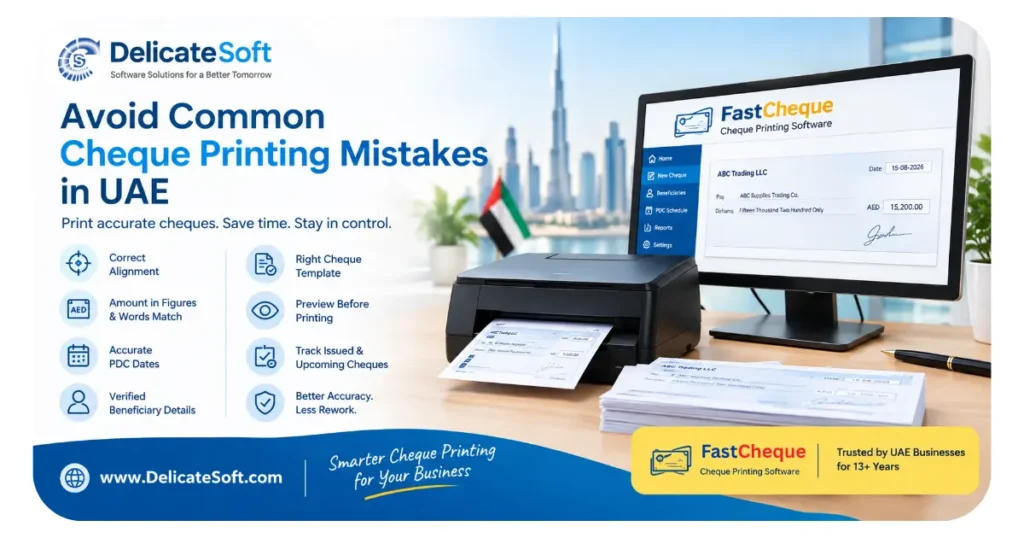
For example, FastCheque from DelicateSoft is designed for UAE businesses that regularly prepare supplier, rent, installment and post-dated cheques. Its features include PDC cheque printing, PDC reminders, batch cheque preparation, cheque history, reporting, payment vouchers and UAE bank cheque templates.
Instead of manually preparing 12 monthly cheques one by one, a finance team can use a payment schedule to prepare multiple future-dated cheques in a controlled workflow.
This is especially useful for companies that manage recurring rent, supplier installments, property payments or other scheduled commitments.
Conclusion
Post-dated cheques continue to play a practical role in the UAE business environment. They can provide structure for installment payments, supplier relationships and cash-flow planning, but they also create responsibilities for both the issuer and recipient.
The most effective approach is to treat every PDC as a controlled financial commitment rather than simply a piece of paper. Businesses should document the underlying transaction, maintain an accurate PDC register, control cheque access, monitor future dates, reconcile payments and understand their bank’s current procedures.
As payment technology continues to evolve, businesses are likely to use a combination of electronic payments and controlled cheque processes. For companies that still issue significant numbers of PDCs, moving from manual cheque preparation to organized digital PDC management can improve accuracy, visibility and financial control.
If your business regularly prepares supplier, rent or installment PDCs in the UAE, explore DelicateSoft’s FastCheque cheque printing software to simplify cheque preparation, batch printing, PDC reminders, cheque history and reporting.