
Introduction: Why UAE Payroll Compliance Matters
UAE payroll compliance is not simply about calculating salaries correctly. For employers, it involves paying employees on time, following the Wage Protection System (WPS), maintaining compliant employment contracts, calculating leave and overtime correctly, handling end-of-service benefits, and maintaining accurate employee records.
These requirements became especially important under the UAE Labour Law framework introduced by Federal Decree-Law No. 33 of 2021, which regulates employment relationships in the private sector. The law covers wages, contracts, working hours, overtime, leave, employee records and end-of-service benefits.
Although many employers searched for payroll compliance guidance, the compliance landscape continues to evolve. For example, the official UAE Government portal now references Ministerial Resolution No. 0340 of 2026 concerning WPS, so employers should always confirm the latest rules rather than relying on an old payroll procedure.
This checklist provides a practical framework for HR teams, payroll managers, accountants and business owners in Dubai and across the UAE.
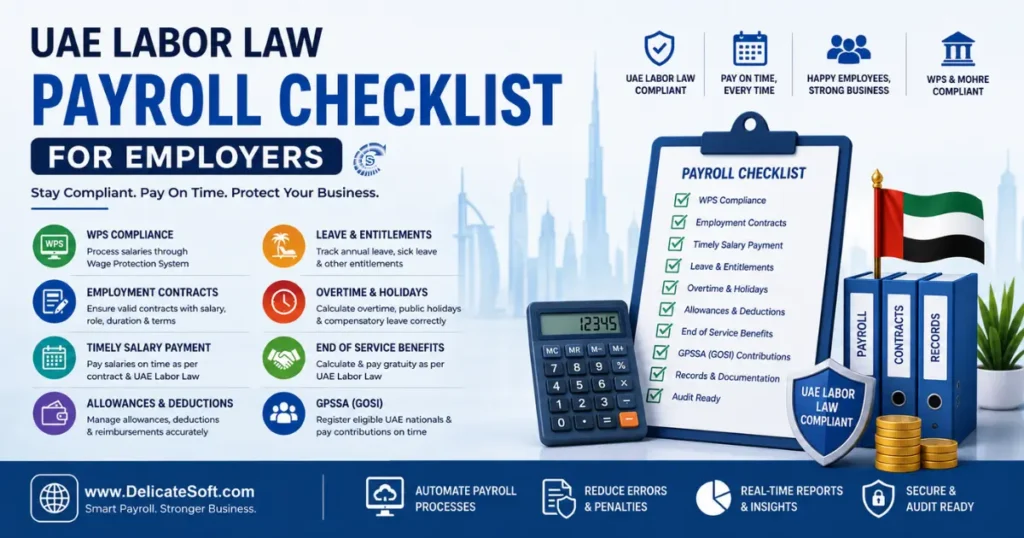
UAE Payroll Compliance Checklist at a Glance
| Payroll area | Employer checklist |
|---|---|
| WPS UAE | Pay wages through the required WPS process and monitor payment status |
| Employment contracts | Ensure salary, job, workplace, duration and terms are correctly documented |
| Monthly payroll | Process salaries accurately and meet the contractual/statutory due date |
| Leave | Track annual, sick and other applicable leave entitlements |
| Overtime | Calculate overtime according to applicable UAE Labour Law rules |
| Allowances | Maintain accurate basic salary and contractual allowances |
| Gratuity | Calculate end-of-service benefits using the correct legal basis |
| GPSSA | Register eligible UAE national employees and process contributions |
| Records | Maintain payroll, attendance, leave and employee documentation |
| Audit readiness | Keep supporting documents consistent and traceable |
1. UAE Payroll Compliance: Registration and WPS Requirements
The Wage Protection System (WPS UAE) is one of the most important parts of payroll compliance for private-sector employers registered with MoHRE.
The official UAE Government guidance states that covered establishments must pay employee wages through WPS on the due date. WPS allows wage payments to be monitored and supports enforcement of timely and complete salary payments.
UAE payroll compliance checklist for WPS
- Confirm that the establishment is correctly registered with MoHRE.
- Use an authorized bank, exchange house or financial institution for WPS salary transfers.
- Ensure employee salary data matches employment records.
- Check that the employee’s bank or payment details are accurate.
- Reconcile the payroll register with the WPS file before submission.
- Investigate rejected, delayed or incomplete salary transactions immediately.
- Keep evidence of salary processing and payment for audit purposes.
Important WPS payment timing rule
Under the current official guidance, salaries are due according to the contractual wage period. The official UAE portal also explains that wages are considered late when payment is not made within the first 15 days after the due date, unless the employment contract provides for a shorter period. The UAE Government portal now notes the 2026 WPS resolution for the current framework.
For payroll teams, the safest approach is simple: do not treat the legal grace period as the target payment date. Build payroll processes so employees are paid on the contractual due date.
2. UAE Payroll Compliance: Employment Contract Requirements
A payroll calculation is only as reliable as the employment data behind it.
Under the UAE private-sector framework, employment contracts must accurately reflect the employment relationship. Official guidance states that the contract should specify information such as the start date, type of work, workplace, terms and conditions, duration and salary.
The UAE private-sector system uses fixed-term contracts, and the previous unlimited-contract model was replaced under the current labour law framework.
Payroll checklist for employment contracts
Confirm that each employee record includes:
- Employee’s full legal name
- Emirates ID and relevant identification details
- Job title and employment type
- Start date
- Workplace or work location
- Contract duration
- Basic salary
- Housing, transport and other contractual allowances
- Payment frequency
- Notice-period terms
- Leave and benefit arrangements where applicable
Payroll teams should also distinguish between basic wage and total wage. Under the Labour Law, basic wage excludes allowances, while wage may include basic wage plus contractual allowances and certain benefits. This distinction is particularly important when calculating overtime and end-of-service benefits.
3. UAE Payroll Compliance: Monthly Salary Payment Rules
Every payroll cycle should begin with a clear salary calendar.
The employer should identify the contractual payroll period, calculate all approved earnings and deductions, perform validation checks, and ensure payment is completed on time.
Monthly payroll checklist
Before finalizing payroll, verify:
- New joiners and employees who left during the month.
- Attendance and approved unpaid absences.
- Basic salary and contractual allowances.
- Overtime and approved additional payments.
- Leave taken during the payroll period.
- Salary deductions that are legally and contractually permitted.
- Bank and WPS information.
- Net salary against the payroll register.
- WPS submission/payment status.
- Final payroll reports and approvals.
A good payroll checklists Dubai process should include at least one independent review before the WPS file is submitted.
4. UAE Payroll Compliance: Leave Salary, Overtime and Allowances
Leave and overtime are common sources of payroll errors because they require HR data and payroll calculations to remain synchronized.
Annual leave
For employees covered by the UAE private-sector Labour Law, annual leave is generally at least 30 days for each completed year of service. Employees with more than six months but less than one year of service are generally entitled to two days per month.
Payroll teams should maintain an accurate leave balance and ensure that leave taken, accrued leave and any eligible leave settlement are correctly reflected in payroll.
Overtime and public holidays
Where an employee works overtime or during an official holiday, compensation must be calculated according to the applicable legal provisions and the employee’s circumstances.
For example, the Labour Law provides that where work is required on an official holiday, the employee may receive another rest day or the normal wage for that day plus an increase of at least 50% of the basic wage, subject to the applicable rules.
Allowance checks
Common payroll allowances include:
- Housing allowance
- Transportation allowance
- Other contractual cash benefits
- Approved commissions or incentives
- Eligible overtime payments
Do not assume an allowance is automatically included in every legal calculation. Payroll should identify whether the relevant law or calculation refers to basic wage, wage, or another defined compensation component.
5. UAE Payroll Compliance: End-of-Service Gratuity and Payout
End of service benefits UAE calculations should be reviewed carefully because errors can create disputes at the time of termination.
For covered expatriate employees on full-time contracts, the official UAE Government guidance states that the employee generally becomes entitled to gratuity after completing at least one year of continuous service. The gratuity is calculated using the basic salary, not allowances such as housing or transport.
The commonly applicable structure is:
- Less than 1 year: no gratuity.
- More than 1 year and less than 5 years: 21 days’ basic salary for each year of service.
- More than 5 years: 30 days’ basic salary for each year after the first five years.
- Total gratuity is subject to the legal cap of two years’ wage.
Employers should also note that the UAE has an optional alternative Savings Scheme for end-of-service benefits. Participating employers follow the scheme’s contribution rules instead of the traditional gratuity system for enrolled employees, after addressing gratuity accrued before enrolment.
For foreign workers covered by the traditional system, the official UAE Government guidance states that outstanding wages, other entitlements and gratuity must be paid within 14 days of contract termination.
6. UAE Payroll Compliance: GOSI/GPSSA Registration for UAE Nationals
For eligible UAE nationals, payroll compliance may also involve pension and social-security contributions through GPSSA, subject to the applicable federal framework and jurisdictional rules.
GPSSA states that employers must register eligible Emirati employees and pay the required contributions. Its current employer guidance states that an Emirati employee should be registered within 30 working days from joining, with delays potentially creating additional employer liabilities.
GPSSA also identifies the contribution structure under the applicable law, including employee and employer contribution percentages. Because pension laws and applicability can depend on employee status, jurisdiction and the relevant scheme, employers should verify the current GPSSA requirements for each employee rather than applying one blanket formula.
Payroll checklist for UAE nationals
- Confirm the employee’s nationality and eligibility.
- Complete required GPSSA registration.
- Verify Emirates ID and employee information.
- Calculate contributions using the applicable contribution salary.
- Process monthly contributions on time.
- Reconcile payroll deductions with GPSSA records.
- Complete end-of-service notifications where required.
7. Penalties and Risks of Poor UAE Payroll Compliance
Payroll non-compliance can create financial, operational and employee-relations risks.
MoHRE has stated that administrative measures may be applied to establishments that do not comply with WPS requirements, with factors including the duration of salary delays and the size and number of affected workers influencing enforcement actions.
The Labour Law also contains significant general penalties for violations. Federal Decree-Law No. 33 of 2021 provides for fines that can range from AED 5,000 to AED 1 million for certain violations, while employer-related fines can vary according to the number of workers involved, with a stated maximum of AED 10 million in the relevant provision.
Possible consequences of payroll failures include:
- WPS-related administrative action
- Salary disputes and employee complaints
- Incorrect gratuity claims
- Reconciliation problems with government records
- Financial penalties
- Increased audit and inspection exposure
- Reputational damage
The exact penalty depends on the type and circumstances of the violation, so employers should check the applicable current legislation and MoHRE decisions.
8. UAE Payroll Compliance: Record-Keeping and Audit Readiness
Good payroll compliance means being able to explain how every salary figure was calculated.
Maintain an organised employee file containing relevant documents such as:
- Employment contract and amendments
- Salary details
- Payroll registers
- WPS payment records
- Attendance records
- Overtime approvals
- Leave records
- Salary deductions
- End-of-service calculations
- GPSSA records for applicable UAE nationals
- Termination and final-settlement documents
A useful audit principle is traceability. A reviewer should be able to move from an employee’s contract to attendance, leave, payroll calculation, WPS payment and final accounting record without unexplained differences.
9. Common Payroll Errors and How to Avoid Them
Even companies with experienced payroll staff can make avoidable mistakes.
Error 1: Using outdated WPS rules
Solution: Review MoHRE and UAE Government guidance regularly. WPS requirements can be updated, as demonstrated by the current 2026 framework.
Error 2: Mixing basic salary and total salary
Solution: Maintain separate payroll fields for basic wage, allowances and total wage.
Error 3: Ignoring contract changes
Solution: Update payroll immediately after approved salary changes, promotions, transfers or allowance amendments.
Error 4: Incorrect leave balances
Solution: Integrate attendance, leave approvals and payroll rather than maintaining disconnected spreadsheets.
Error 5: Incorrect gratuity calculation
Solution: Calculate gratuity using the applicable legal rules and confirm the correct basic salary and service period.
Error 6: Missing GPSSA actions
Solution: Include UAE national registration and contribution checks in the monthly payroll control process.
Error 7: Relying on manual calculations
Solution: Use structured payroll software with validation, audit trails and automated calculations. Tools such as EasyHR HR and payroll software can help employers centralise payroll, employee records, leave and WPS-related processing in one system.
10. Practical UAE Labour Law Payroll Checklist
Use this checklist before closing each monthly payroll:
- Confirm all active employees and recent joiners.
- Check employment contracts and salary amendments.
- Verify basic salary and allowances.
- Import or validate attendance data.
- Review overtime and holiday work.
- Update annual and other applicable leave records.
- Check unpaid absences and authorised deductions.
- Verify WPS employee and salary data.
- Generate and review the payroll register.
- Process salary payments through the required WPS channel.
- Confirm successful payment status.
- Review GPSSA obligations for applicable UAE nationals.
- Reconcile payroll totals with accounting records.
- Archive payroll reports and supporting documents.
- Review exceptions before closing the payroll period.
Conclusion: Build a Payroll Process That Is Ready for UAE Compliance
UAE payroll compliance requires more than paying salaries every month. Employers need a repeatable process covering WPS, employment contracts, salary calculations, leave, overtime, allowances, end-of-service benefits, GPSSA obligations and payroll records.
For businesses in Dubai, Abu Dhabi and other UAE emirates, the most effective approach is to turn compliance requirements into a documented monthly payroll checklist rather than relying on memory or manual spreadsheets.
As payroll rules evolve, HR and finance teams should also monitor updates from MoHRE, GPSSA and the official UAE Government portal and review internal payroll procedures accordingly.
For companies looking to reduce manual payroll work, EasyHR payroll software can provide a centralised way to manage employee data, payroll calculations, leave, attendance and WPS-related processes.
Ready to simplify your payroll process?
Explore EasyHR payroll software for UAE and see how automated payroll workflows can help your business maintain more consistent UAE payroll compliance while reducing manual errors.
Note: This article is an informational guide, not legal advice. UAE labour and payroll rules can change, so employers should verify requirements with MoHRE, GPSSA and the relevant UAE authority before making compliance decisions.