Top 10 HR Trends in UAE 2026
The UAE workplace is changing rapidly. Artificial intelligence is becoming part of daily business operations, Emiratisation targets are shaping recruitment strategies, employees expect more flexible and personalised work experiences, and HR teams are under increasing pressure to improve compliance while supporting business growth.
For HR managers, business owners and senior decision-makers, 2026 is not simply another year of digital transformation. It is a year when HR strategy, workforce planning, technology and national economic priorities are becoming more closely connected.
The most important HR trends UAE 2026 are therefore different from generic global workplace trends. UAE businesses must manage a highly diverse workforce, comply with evolving employment requirements, develop UAE National talent, adopt new technologies responsibly and compete for skilled professionals in a fast-growing economy.
This guide explores the top 10 UAE HR trends expected to influence recruitment, employee management, payroll, workforce development and the future of work UAE businesses are building.
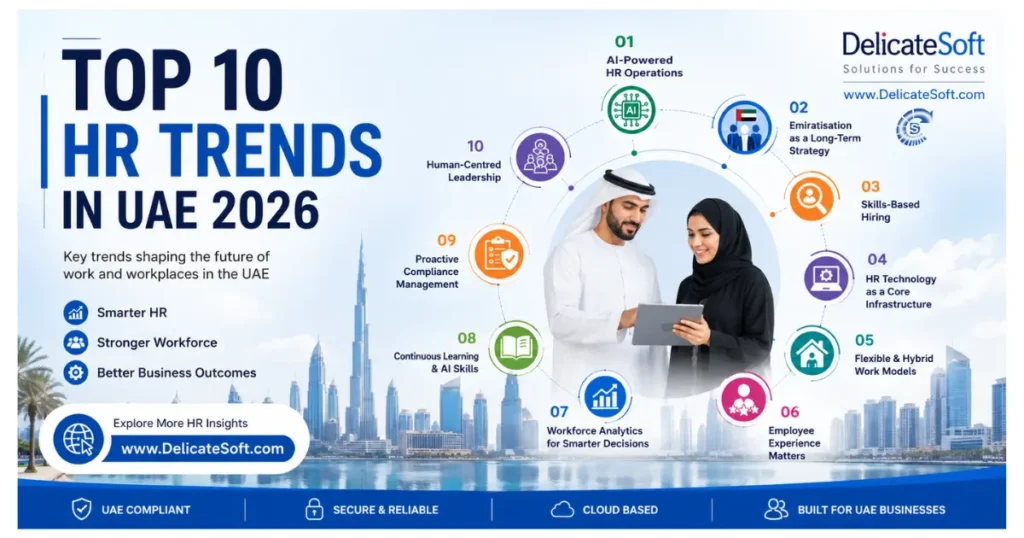
1. AI-Powered HR Moves From Experiment to Everyday Operations
Artificial intelligence is expected to become a practical HR tool rather than a technology used only for experimentation. In 2026, more UAE companies will use AI to support recruitment, employee communication, workforce analytics, learning and routine HR administration.
AI can help HR teams analyse large volumes of information, identify patterns and reduce repetitive work. However, the strongest results will come from using AI to support human decision-making rather than replacing HR professionals.
Why This Matters in the UAE
The UAE has made artificial intelligence a major national priority and continues to invest in digital infrastructure, innovation and advanced skills. This creates pressure on businesses to improve productivity while preparing employees for AI-enabled roles.
For HR departments, the opportunity is to automate time-consuming activities such as:
- CV screening and candidate shortlisting
- Employee query management
- HR document drafting
- Training recommendations
- Workforce reporting
- Employee sentiment analysis
- Skills-gap identification
AI should still be used with appropriate human review, particularly when decisions affect recruitment, promotions, performance or employee rights.
Practical Example
A growing UAE company may receive hundreds of applications for a single position. AI can help organise applications according to defined skills and experience requirements, while HR managers remain responsible for reviewing candidates and making final hiring decisions.
Actionable Step for HR Leaders
Start with two or three low-risk HR processes that involve repetitive administrative work. Measure the time saved, review the quality of results and establish clear rules for human approval before expanding AI use.
2. Emiratisation Becomes a Long-Term Talent Strategy
Emiratisation will remain one of the most important human resources UAE 2026 priorities. Companies are moving beyond treating Emiratisation as a recruitment target and are increasingly focusing on retention, career development, leadership pathways and meaningful workforce participation.
Private-sector companies with 50 or more employees are required to achieve annual growth in Emirati employees working in skilled positions. The UAE also applies Emiratisation requirements to selected businesses with 20 to 49 employees operating in specified sectors.
In 2026, MoHRE is also continuing its semi-annual approach, with eligible companies expected to achieve a 1% increase in Emiratisation targets during the first half of the year.
Why This Matters in the UAE
Recruiting an Emirati employee is only the first stage. Businesses must create a workplace where UAE Nationals can build skills, contribute to strategic projects and develop long-term careers.
Companies that focus only on meeting numerical targets may face challenges with employee engagement and retention. A more sustainable strategy includes structured onboarding, mentorship, career planning and regular development discussions.
Practical Example
A UAE company may create a graduate development programme that rotates Emirati employees through HR, finance, operations and business development. This gives employees broader experience while helping the company develop future managers.
Actionable Step for HR Leaders
Create an Emiratisation workforce plan covering:
- Recruitment targets
- Employee onboarding
- Training and development
- Mentorship
- Career progression
- Retention indicators
- Succession planning
Review progress throughout the year rather than waiting until a compliance deadline.
3. Skills-Based Hiring Gains Importance
Traditional recruitment often focuses heavily on job titles, qualifications and years of experience. In 2026, more UAE employers are expected to adopt skills-based hiring, particularly for technology, digital, finance, operations and emerging business roles.
Skills-based recruitment evaluates what candidates can do, not only where they worked or which qualifications they hold.
Why This Matters in the UAE
The UAE labour market is highly international and competitive. Employers recruit professionals from many countries, each with different education systems and career backgrounds.
A skills-based approach can help HR teams compare candidates more consistently and identify talent that may be overlooked by traditional screening methods.
Important skills may include:
- AI and digital literacy
- Data analysis
- Cybersecurity awareness
- Communication
- Project management
- Customer experience
- Financial and commercial understanding
- Adaptability
Practical Example
Instead of requiring five years of experience for every HR technology role, an employer may ask candidates to complete a practical task involving employee data, HR reporting or workflow design.
Actionable Step for HR Leaders
Review your most important job descriptions. Separate essential skills from preferred qualifications and identify which capabilities can be assessed through practical assignments, structured interviews or skills tests.
4. HR Technology Becomes a Core Business Infrastructure
In 2026, HR software will increasingly be viewed as essential business infrastructure rather than an administrative tool.
Growing companies need accurate employee records, payroll information, leave balances, attendance data, documents and workforce reports. Managing these processes through spreadsheets and disconnected systems creates unnecessary risks.
Why This Matters in the UAE
UAE businesses must manage diverse workforces, multiple employment arrangements and important compliance processes. HR teams may also need to coordinate payroll, WPS requirements, employee documentation, leave management and end-of-service calculations.
The UAE Labour Law recognises several work arrangements, including full-time, part-time, temporary, flexible, remote work and job sharing.
As work arrangements become more varied, HR systems need to provide a reliable and central view of employee information.
Practical Example
A company with 300 employees may use one HR platform to manage employee records, leave requests, payroll, attendance, document expiry reminders and employee self-service.
This reduces duplicate data entry and gives management faster access to workforce information.
Actionable Step for HR Leaders
Audit your current HR processes and identify where information is duplicated or managed manually. Prioritise systems that provide:
- Centralised employee records
- Payroll automation
- Leave management
- Employee self-service
- Attendance integration
- HR reporting
- Document expiry alerts
- Secure access controls
5. Flexible and Hybrid Work Become More Structured
Flexible work will continue to influence the future of work UAE businesses are creating. However, the focus is shifting from informal remote-work arrangements to clear policies that balance employee flexibility, productivity and business requirements.
Remote and flexible work are recognised work arrangements under the UAE private-sector employment framework.
Why This Matters in the UAE
Dubai’s growth as a global business destination, the UAE’s remote-work initiatives and the continuing impact of the Expo legacy have strengthened the country’s position as an international hub for talent, entrepreneurship and flexible business models.
At the same time, many UAE industries require employees to work on-site. Construction, hospitality, retail, healthcare, logistics and manufacturing cannot apply the same flexibility as technology or professional-services businesses.
The key trend is therefore not universal remote work. It is role-based flexibility.
Practical Example
A professional-services company may allow employees to work remotely one or two days per week, while customer-facing teams follow a structured office schedule.
Performance is measured through agreed objectives rather than physical presence alone.
Actionable Step for HR Leaders
Develop a written flexible-work policy that defines:
- Eligible roles
- Approval procedures
- Work schedules
- Availability expectations
- Information-security requirements
- Performance measures
- Equipment responsibilities
6. Employee Experience Becomes a Retention Strategy
Employee experience is becoming more important as UAE employers compete for skilled professionals. Employees increasingly evaluate the complete employment experience, including onboarding, communication, career growth, workplace culture, technology and manager support.
In 2026, companies will focus more on reducing unnecessary employee friction.
Why This Matters in the UAE
The UAE workforce includes employees from many nationalities, cultures and professional backgrounds. A standard approach may not meet the expectations of every employee group.
HR teams will need to create consistent policies while offering relevant and accessible employee support.
Practical Example
Instead of asking employees to contact HR for every request, a company may introduce an employee self-service portal where staff can:
- Apply for leave
- Download payslips
- Update personal information
- Submit HR requests
- View leave balances
- Access company documents
Actionable Step for HR Leaders
Map the employee journey from recruitment to exit. Identify the three processes that cause the most delays or employee frustration and improve them first.
7. Workforce Analytics Supports Better Business Decisions
HR analytics is moving beyond basic headcount reports. In 2026, management teams will expect HR to provide insights into workforce costs, employee turnover, recruitment performance, productivity and future talent requirements.
The value of HR analytics is not the number of dashboards. It is the ability to answer important business questions.
Why This Matters in the UAE
Businesses are operating in a fast-changing environment influenced by economic diversification, new investment, technology adoption and national workforce priorities.
HR leaders need reliable information to support decisions about hiring, workforce costs, Emiratisation, succession and expansion.
Useful HR Metrics
HR leaders may track:
- Employee turnover rate
- Average time to hire
- Recruitment cost
- Employee retention by department
- Absenteeism
- Leave trends
- Training participation
- Payroll cost by business unit
- Emiratisation progress
- Internal promotion rates
Practical Example
An HR dashboard may show that employee turnover is highest during the first six months of employment. The company can then review its recruitment, onboarding and manager-support processes.
Actionable Step for HR Leaders
Select five HR metrics directly connected to business objectives. Review them monthly and include actions, not only statistics, in management reports.
8. Continuous Learning and AI Skills Become Business Priorities
The rapid adoption of AI is increasing demand for continuous learning. In 2026, HR teams will be expected to support both technical development and practical workplace skills.
The most successful learning programmes will connect training to real business outcomes.
Why This Matters in the UAE
The UAE’s economic vision is focused on innovation, knowledge-based industries, advanced technology and sustainable growth. Workforce skills must develop alongside these priorities.
Employees do not all need to become AI specialists. However, many will need to understand how to use AI tools responsibly, evaluate outputs and protect confidential information.
Practical Example
An HR department may provide separate AI learning paths for:
- HR professionals
- Managers
- Finance teams
- Sales employees
- Administrative staff
- Technology specialists
Each programme can focus on relevant workplace applications.
Actionable Step for HR Leaders
Create a skills inventory for critical roles. Identify current capabilities, future requirements and the highest-priority skills gaps.
Link training to practical projects so employees can apply new knowledge.
9. Compliance Becomes More Proactive and Technology-Driven
HR compliance is becoming a continuous management responsibility rather than an annual review.
UAE employers must maintain accurate employee information and manage employment processes according to applicable laws and regulations. This includes areas such as employment contracts, wages, leave, working arrangements, employee records and end-of-service obligations.
Why This Matters in the UAE
Manual compliance processes can create risks when employee information is incomplete, documents expire or payroll records are inconsistent.
As companies grow, HR teams need systems that provide reminders, records and audit-ready information.
Practical Example
An HR platform can automatically alert the HR team before an employee’s passport, visa, Emirates ID, labour-related document or professional certification expires.
Actionable Step for HR Leaders
Create a monthly HR compliance checklist covering:
- Employee records
- Employment contracts
- Payroll and WPS processes
- Leave balances
- Document expiry dates
- Emiratisation requirements
- Employee policy acknowledgements
- End-of-service records
Use automated reminders wherever possible.
10. Human-Centred Leadership Becomes a Competitive Advantage
Technology can automate many HR activities, but leadership remains a human responsibility.
In 2026, employees will continue to expect managers to provide clarity, fair treatment, feedback, recognition and career support.
Why This Matters in the UAE
The UAE’s multicultural workforce requires leaders who can communicate effectively across different backgrounds and working styles.
As AI changes job responsibilities, employees may also need more guidance about how their roles will evolve.
Strong managers help employees understand business priorities and build trust during periods of change.
Practical Example
A company introducing AI tools may train managers to explain:
- Which tasks will change
- Which skills employees should develop
- How performance will be evaluated
- Where human judgement remains essential
Actionable Step for HR Leaders
Provide practical manager training in:
- Giving feedback
- Managing diverse teams
- Supporting employee development
- Leading hybrid teams
- Using AI responsibly
- Handling workplace change
Key Takeaways: HR Trends UAE 2026
The leading HR trends in the UAE are connected by one important theme, HR is becoming more strategic, data-driven and technology-enabled while remaining focused on people.
The key priorities for UAE organisations include:
- Using AI to improve HR productivity responsibly
- Building sustainable Emiratisation strategies
- Recruiting based on practical skills
- Investing in integrated HR technology
- Creating structured flexible-work policies
- Improving employee experience
- Using workforce analytics for business planning
- Developing AI and future-ready skills
- Managing compliance proactively
- Strengthening leadership capabilities
The Future of Work UAE: What to Expect in 2027
Looking ahead to 2027, HR is likely to become even more integrated with business strategy.
AI may automate more routine HR activities, while HR professionals focus increasingly on workforce design, talent development, organisational culture and leadership.
Emiratization is also expected to remain a long-term workforce priority, with greater attention on career progression, retention and leadership development.
Companies that invest in reliable HR data, employee development and scalable technology during 2026 will be better prepared for the next stage of the UAE’s economic and workforce transformation.
Manage Your UAE Workforce More Efficiently with EasyHR
Keeping up with changing UAE HR trends requires more than policies and spreadsheets. Businesses need a reliable system to manage employee information, payroll, leave, attendance, HR documents and workforce processes from one central platform.
EasyHR by Delicate Software Solutions helps UAE businesses simplify HR and payroll administration, improve visibility and support more efficient employee management.
Explore our HR and Payroll Software in UAE to discover how EasyHR can help your business manage HR operations with greater accuracy, efficiency and control.
Explore EasyHR, HR and Payroll Software for UAE Businesses
Author Bio
About the Author: Balbir Singh is an HR and business technology writer specialising in UAE workforce management, HR compliance, payroll technology and the future of work. The author creates practical content for HR professionals, business owners and decision-makers across the UAE.
Stay ahead of UAE HR changes with practical insights, smarter HR processes and technology built for growing businesses.